Every Traditional Hiring Signal Is Breaking Simultaneously

Run three technical screens this month and you will likely see the same pattern: comprehensive, technically accurate answers to questions that should require synthesis and tradeoff judgment. The responses are perfect. And completely hollow.
No experienced engineer talks that way when explaining a system they've actually built. The traditional heuristic still works for now: bend the question slightly, add a constraint, ask them to defend a tradeoff. A real engineer adapts. Someone reading from external assistance stalls or pivots to a canned answer that doesn't fit.
That window is closing. Language models already adapt to follow-up questions more fluidly than they did six months ago.
AI has made technical output cheaper while leaving technical judgment unchanged. That single shift is degrading most hiring signals we've relied on for twenty years, simultaneously.
Watch Each Signal Degrade
Resume. Used to mean: I built this. Now means: AI helped me write this, and I may or may not have built any of it. Employers report weaker signal quality across application materials, with polished presentation no longer reliably indicating technical capability. Well-qualified engineers feel systematically ignored by companies they should match. The market hasn't disappeared: significant hiring activity continues, particularly in AI-adjacent and infrastructure roles. But employers and candidates operate on fundamentally different assumptions about what the other side is evaluating, because the signals connecting them have degraded.
Cover letter. Used to indicate communication ability and motivation. Now indicates access to ChatGPT. The signal rarely means what it used to.
Coding interview. Used to measure problem-solving under constraints. Now everyone has Claude in their pocket during the Zoom call. The pattern I keep hearing: candidates produce clean solutions to algorithmic problems, then hesitate or retreat to generic principles when asked why they chose that approach over an alternative.
System design interview. Used to measure experience and architectural judgment. Now candidates arrive with AI-generated templates for common scenarios. Change one assumption halfway through and watch what happens: some candidates keep defending the original answer without noticing the constraint shifted. Others adapt cleanly. The interview no longer distinguishes experience from rehearsal as reliably as it did eighteen months ago.
Take-home project. Used to show independent work quality. Now projects can be substantially AI-generated. Determining authorship becomes difficult without follow-up conversation about implementation details and decisions made during construction.
The pattern isn't subtle. Most proxies we've used to evaluate engineering capability have become systematically less trustworthy in the same window.
What Suddenly Becomes More Valuable
When generated signals degrade, earned signals compound.
Prior coworkers. If someone you respect vouches for a candidate's judgment, integrity, and execution capability, that matters more than any structured interview. Senior roles increasingly fill through referrals and direct outreach rather than public application processes, precisely because employers need validation they can trust.
Reputation. Consistent public evidence of judgment, technical depth, and contribution quality. Open-source commits with meaningful review history. Technical writing that demonstrates systems thinking. Shipped products with users. These signals are harder to fake than a polished resume.
Previous execution under observation. Contractors who deliver, early employees who shipped during chaos, technical advisors who made good calls. Evidence of performance in high-context environments where someone credible was watching.
What distinguishes artificial signals from earned signals: artificial signals can be synthesized in an afternoon. Earned signals require sustained performance validated by people whose judgment you trust.
The Senior Multiplier Effect
A junior engineer assisted by AI produces output without the judgment to validate whether that output is sound. They generate code. They cannot yet evaluate whether that code solves the right problem, introduces technical debt, or creates downstream complexity.
A senior engineer assisted by AI produces dramatically more leverage than the same senior without AI, because they can validate, refine, and integrate AI-generated work at speed. The bottleneck shifts from "how fast can I write this" to "how well can I evaluate whether this is the right thing to build."
AI amplifies judgment, not syntax. Senior engineers have better judgment. Therefore AI makes senior engineers disproportionately more valuable.
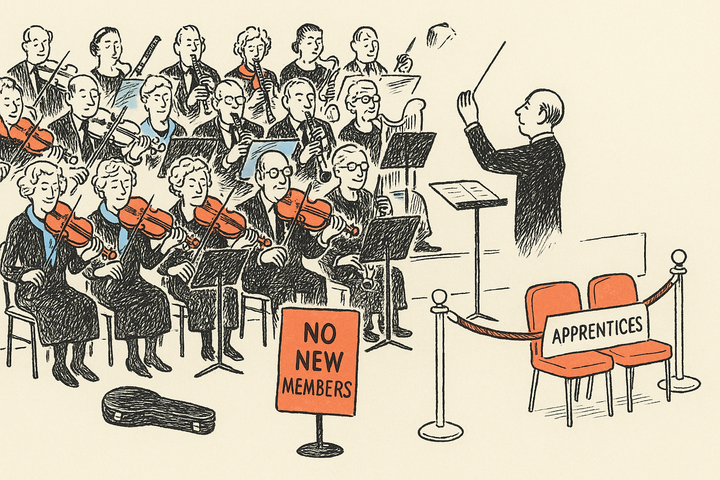
This creates the training paradox visible across the current market. Junior engineers struggle to get hired because they lack experience using AI effectively in production contexts. But they cannot gain that experience without employment. Demand concentrates in specialized roles: narrow, high-context domains requiring autonomous execution. The broad generalist junior pipeline has contracted.
The market hasn't collapsed. It has specialized. Companies hire for proven capability in specific contexts rather than potential across general technical skill.
AI Interviewers: Efficiency Versus Authority
Some companies deploy AI-powered interviewers: systems that ask standardized questions, evaluate responses, and produce scored transcripts for human review. The economic logic is clear. Phone screens consume significant time and produce weak signal. If AI can filter clearly unqualified candidates before humans invest hours, that's leverage.
The distinction that matters: AI as screening efficiency versus AI as evaluation authority.
Using AI to structure initial conversations, ensure consistent question coverage, or flag obvious disqualifications is process tooling. An AI system conducts a 20-minute technical screen covering fundamental data structures and system design vocabulary, produces a transcript with flagged concerns, and routes clearly unqualified candidates out of the funnel before human time investment. The human reviewer still makes the hiring decision, but only evaluates candidates who clear baseline thresholds.
Using AI to make hiring decisions based on scored transcripts without meaningful human interaction introduces risk. Companies hire people who will work with other people, not transcripts. Exams test retrieval and structured problem-solving. Work requires navigating ambiguity, collaborating across disciplines, making tradeoffs without complete information, and adapting as context shifts. AI can evaluate the former. It cannot yet evaluate the latter, because success depends on interpersonal dynamics that only emerge through human interaction.
What Actually Needs Measuring
Engineering interviews never existed to verify correct answers. If correctness were sufficient, written exams would work. Interviews evaluate judgment, reasoning process, communication under pressure, intellectual honesty, and whether this person makes the team stronger.
The qualities that matter haven't changed:
Critical reasoning. Can they distinguish between surface-level correctness and structural soundness? When an approach technically works but creates future problems, do they catch it?
Mastery over prior work. Can they explain decisions they made in previous systems with technical precision and context awareness? Do they understand why they made specific tradeoffs, or just what they shipped?
Adaptability. When constraints change mid-problem, do they re-anchor or double down on an approach that no longer fits?
Ownership. Do they treat problems like something they're responsible for solving, or like something they're performing solutions for?
Integrity. Are they representing their own knowledge, or orchestrating a performance?
AI assistance makes all of these harder to measure directly. A candidate using AI well demonstrates adaptability and tool leverage. A candidate using AI poorly demonstrates dependency without discernment. A candidate using AI fraudulently demonstrates nothing about their capabilities. Distinguishing these cases in a 60-minute conversation becomes increasingly difficult as the tools improve.
Industry practice is shifting toward applied skill demonstration rather than abstract problem-solving. Portfolio evidence and real-world competence provide clearer differentiation than academic knowledge alone, precisely because those signals are harder to fake.
The Underlying Structure
This isn't cyclical downturn or temporary market correction. It's structural phase change.
Employers try to hire judgment and integrity. Candidates try to demonstrate competence. AI has made competence demonstrations unreliable while simultaneously raising the judgment threshold required for effective performance.
The market remains active, with AI fluency increasingly described as baseline rather than specialized. But activity concentrates in roles requiring proven judgment under ambiguity: senior positions, specialized domains, high-context environments where reputation and referrals matter more than interview performance.
Organizations that recognize traditional evaluation methods have degraded and redesign their hiring systems accordingly build sustainable competitive advantage. The rest continue optimizing processes that no longer measure what matters.
The tactical work: identify which capabilities actually drive outcomes in your specific context. Map your current evaluation methods against those capabilities. Replace methods that have lost reliability with higher-fidelity alternatives that preserve signal quality. Iterate based on hiring outcomes rather than industry convention.
Concretely: leverage trusted networks aggressively, because referrals from operators whose judgment you respect cut through noise better than any structured process. Replace standardized interviews with scoped work samples that mirror actual job responsibilities, and pay candidates for their time. Structure conversations around judgment rather than output: ask about tradeoffs they chose not to make, systems that created downstream problems, decisions they would reverse with current knowledge. Use multi-stage evaluation where you progressively add constraints and observe how candidates adapt their thinking rather than patch their initial answers.
Treat junior hiring as long-term mentorship investment rather than scalable pipeline, because the training economics have fundamentally shifted.
When traditional signals break down, the operators who recognize it fastest and redesign their evaluation systems accordingly gain sustainable hiring advantage. The rest keep interviewing the way they did in 2019, wondering why their quality of hire has declined.